

By: Jan Dominy
It is two o’clock in the morning, and someone has been talking to ChatGPT for hours.
Not because they need help writing an email or debugging code, but because they have spent the last three hours replaying an argument with their partner. They cannot decide whether they were unreasonable, whether they overreacted, or whether they have somehow become impossible to love. Ordinarily, this might be the moment they wake a friend, fill pages in a journal, or count the days until their next therapy appointment. Instead, they open an AI chatbot and begin typing.
They describe the argument in exhausting detail. They explain the history leading up to it, recount the exact words that were exchanged, and work through years of context that no search engine could ever understand. The chatbot asks thoughtful follow-up questions, points out cognitive distortions, suggests alternative interpretations of the conflict, and gently challenges conclusions that had felt obvious only minutes earlier. An hour passes almost without notice.
When they finally close the conversation, nothing about their circumstances has changed. The relationship may still be in trouble. Tomorrow’s problems have not disappeared. Yet something undeniably feels different. Their breathing has slowed. Their thoughts have become more organized. The emotional knot that seemed impossible to untangle now feels loose enough to examine.
If that scenario sounds familiar, you are far from alone.
Millions of people have quietly begun using artificial intelligence to process emotions, organize difficult thoughts, rehearse uncomfortable conversations, or simply think out loud without interruption. Increasingly, people describe this experience as AI therapy, whether or not a licensed therapist is involved. The practice has sparked predictable debate. Some therapists view it as a dangerous substitute for mental health care. Others dismiss it as little more than sophisticated autocomplete wrapped in comforting language. Meanwhile, the people actually using it often report something much simpler.
“It helped.”
I believe them.
That statement should not make psychologists defensive. It should make us curious.
Over the past year, I have spent hundreds of hours exploring how people use generative AI for reflection, creativity, communication, and increasingly, emotional support. The more I study the technology, the less interested I become in whether AI can replace therapists and the more interested I become in what it reveals about us.
If conversations with artificial intelligence genuinely help people feel calmer, think more clearly, or better understand themselves, then perhaps we have been asking the wrong question. Rather than debating whether AI can replace therapy, we should begin by asking what therapy actually is. Only then can we understand which parts artificial intelligence performs remarkably well, which parts it can only imitate, and why that distinction tells us something important about human beings.
Therapy Is Not One Thing

We often talk about therapy as though it were a single service. We ask whether therapy “works” or whether AI can “replace therapy,” as though every minute spent in a therapist’s office accomplishes the same goal.
It doesn’t.
A good therapist performs many different roles, often within the same session. They teach psychological concepts that help clients understand themselves, identify patterns that have remained invisible for years. Therapists challenge distorted thinking, encourage healthier behaviors, and provide accountability when old habits begin pulling someone backward. Sometimes they simply witness another person’s pain without rushing to solve it.
All of those experiences fall under the umbrella of therapy, but they are not the same psychological process.
Once we recognize that, the conversation about AI changes dramatically.
Artificial intelligence excels at certain aspects of therapeutic work. It organizes scattered thoughts into coherent narratives, explains attachment theory, cognitive behavioral therapy, or family systems in language that matches a person’s level of understanding, patiently explores an idea from multiple angles without becoming frustrated or distracted. It remembers conversations from weeks ago and notices recurring themes that many people overlook in themselves.
Those abilities matter because thinking clearly changes lives.
The mistake people make is assuming that because AI performs some therapeutic functions exceptionally well, it must therefore perform all of them equally well. That conclusion misunderstands both psychotherapy and artificial intelligence.
Why It Works So Well for Me
My own experience with AI probably differs from many people’s because of my background in psychology and sociology. I don’t expect it to diagnose me or tell me what to believe, and I don’t mistake confidence for expertise or fluency for wisdom. Instead, I use it as an extraordinarily capable thinking partner.
When I write, I use AI to pressure-test ideas, identify weaknesses in an argument, explore competing perspectives, and organize concepts that would otherwise remain scattered across dozens of browser tabs and notebooks. When I reflect on my own life, I ask it to challenge my assumptions, point out possible cognitive distortions, and remind me of theories that might explain what I am experiencing. Sometimes I agree with its conclusions, oftenI don’t.
The disagreement is part of the value.
Unlike a journal, AI talks back, never grows tired of hearing me revisit the same problem for the twentieth time, understands the context surrounding the question instead of forcing me to start over every time I ask something new.
For someone who already possesses a foundation in psychology, the experience feels less like consulting an oracle and more like collaborating with an endlessly patient colleague.
I don’t think AI replaces my thinking.
I think it gives my thinking somewhere to happen.
The Loneliness Question We Keep Avoiding
The more I watch this conversation unfold, the more convinced I become that AI therapy is not really a story about artificial intelligence.
It is a story about loneliness and the growing shortage of meaningful human connection.
The American Psychological Association has devoted enormous attention to the growing epidemic of loneliness and social isolation in the United States. The former Surgeon General described loneliness as a public health crisis, comparing its health consequences to well-established physical risk factors. Whether we measure fewer close friendships, declining participation in community organizations, increasing geographic mobility, or the simple reality that many adults struggle to find someone willing to listen without judgment, the pattern remains remarkably consistent.
People feel alone.
Against that backdrop, it should surprise no one that millions of people have begun talking to software.
AI did not create our loneliness.
It revealed it.
People are not flocking to chatbots because machines have suddenly become superior companions. They are using them because attentive, patient, emotionally available conversation has become increasingly difficult to find. Friends have jobs, families, responsibilities, and limits. Therapists have waitlists. Many people cannot afford weekly appointments. Others simply need somewhere to think at two o’clock on a Tuesday morning.
Artificial intelligence arrived at exactly the moment society created enormous demand for uninterrupted conversation. Recent surveys from the American Psychological Association found that nearly seven in ten Americans needed more emotional support than they received during the previous year. When millions of people share the same unmet need, it should not surprise us that many eventually seek conversation wherever conversation is available.
That should concern us far more than the technology itself.
Harry Harlow’s Wire Monkey
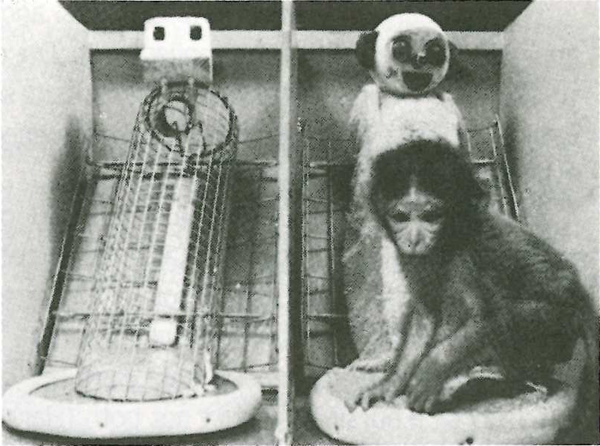
Long before anyone imagined artificial intelligence, psychologist Harry Harlow conducted one of the most influential and controversial experiments in developmental psychology. Infant rhesus monkeys were given two surrogate mothers. One consisted of little more than wire and a bottle of milk, while the other offered no food but was covered in soft cloth.
The monkeys consistently chose the cloth mother. Whenever something frightened them, they did not run toward the source of nourishment. They ran toward comfort.
People often summarize Harlow’s work by saying that babies need affection, but I think that interpretation misses the deeper lesson. Food and connection solve different biological problems. One keeps the body alive, while the other teaches the nervous system what safety feels like. Those needs complement one another rather than compete, and Harlow’s experiments demonstrated that nourishment alone can never produce emotional security.
Cuddling the Wire Monkey
Whenever people ask whether AI can replace therapy, I find myself thinking about Harlow’s wire monkey. The wire mother provided something essential. It kept the infant monkeys alive. Yet no amount of nourishment could replace the comfort, safety, and emotional regulation they found in the cloth mother. Harlow’s experiment was never really about choosing one over the other. It revealed that different needs require different kinds of care.
Artificial intelligence occupies a remarkably similar place in our lives. It feeds us ideas, organizes our thinking, remembers details we have forgotten, helps us untangle emotional knots, and often provides genuinely useful psychological insight. In some respects, it performs those cognitive tasks more consistently than another person ever could.
That has real value. Clarity changes behavior. Understanding ourselves better changes relationships, and organizing our thoughts often reduces anxiety all by itself. Human beings regulate emotion through language, so translating overwhelming feelings into a coherent narrative frequently lowers their intensity. AI excels at guiding that process when no other person is available.
None of that, however, allows artificial intelligence to share in the experience of being human. It can recognize patterns in grief without mourning someone it loved, generate comforting words without feeling relief when you tell it that you are finally okay, and encourage you through heartbreak, celebrate your successes, but it never experiences hope, concern, joy, or loss alongside you. It can simulate those moments with astonishing skill, yet simulation is not participation.
That distinction matters because healing is not only about understanding ourselves. It is also about being understood by another living nervous system.
The Future Is Partnership, Not Replacement
Therapists who view AI primarily as competition may be asking the wrong question.
Imagine clients arriving at therapy with weeks of organized reflections, timelines of important life events, identified cognitive distortions, drafted boundary conversations, and thoughtful questions that emerged through conversations with AI between sessions.
Instead of spending valuable time reconstructing the facts of a situation, therapists could spend more time exploring what those facts actually mean.
Artificial intelligence could become one of the most effective preparation tools psychotherapy has ever seen. It can shoulder enormous amounts of cognitive work, leaving therapists free to focus on the parts of healing that require another human being.
The future of AI therapy may not involve choosing between psychologists and artificial intelligence.
It may involve understanding exactly what each does best.
We Were Never Trying to Replace the Cloth Monkey
The growing popularity of AI therapy does not convince me that human connection has become obsolete. If anything, it convinces me of the opposite. Millions of people are searching for somewhere to think and communicate honestly without interruption, judgment, or exhaustion. Artificial intelligence has met that need with remarkable effectiveness, and I suspect it will continue doing so for years to come.
Thinking and communicating, however, have never been the same activity.
Harry Harlow’s monkeys understood something profound long before any of us carried powerful computers in our pockets. When life becomes frightening, confusing, joyful, or unbearably painful, information alone is never enough. Mammals reach for warmth, presence, and responsive connection because those experiences shape us in ways knowledge never can.
AI can help us think. In many cases, it can even help us begin to heal. Healing, however, has always depended on more than insight alone. Eventually, every healthy nervous system reaches toward another living one.
Artificial intelligence has not replaced that truth.
If anything, it has reminded us how deeply we still need each other.
Leave a Reply